You didn’t get into the restaurant business to hand 30% of every delivery order to a third-party app. But if UberEats, DoorDash, or Grubhub is still your primary delivery channel, that’s exactly what’s happening.
The good news: making the switch to first-party food delivery software is more practical than it’s ever been. The tools have matured, the integrations have gotten simpler, and the operators using them are seeing real differences in their bottom line.

This guide covers:
- What to look for in a first-party food delivery management system
- Why AI ordering is reshaping the delivery landscape in 2026
- Our five top restaurant food delivery software recommendations
Let’s get into it.
Why Restaurants Are Switching to First-Party Food Delivery Software
There are at least 30 reasons to move away from third-party delivery apps, starting with the fact that they charge up to 30% per order. But the case for first-party delivery management software goes beyond recovering revenue. Restaurants that make the switch also gain:
| Benefits | Notes |
| Seamless POS integration — Order data flows directly into your system, with smart route mapping to keep deliveries on time. | Not all platforms support real-time order tracking. Guest expectations for live delivery visibility have grown significantly, and falling short can affect repeat business. |
| Full driver management — Track your team’s performance, manage schedules, and monitor driver credentials from one place. | Look for DoorDash Drive integration. When an unexpected rush hits or a driver calls in sick, tapping a third-party driver network on your own terms is a practical backup. |
| More revenue on every order — Without third-party commission fees, your per-order economics look very different. | Software costs vary, so evaluate total cost against your current third-party spend. For most restaurants with consistent delivery volume, the math favors first-party delivery. |
| Full ownership of guest data — Order history, preferences, and contact details belong to you, not a platform. | The depth of data capture depends on how well your delivery software connects with your loyalty and marketing tools. |
A New Frontier: AI Ordering and Delivery in 2026
Something has shifted meaningfully since we last looked at this space. AI has moved from a talking point to a genuine operational tool for delivery-driven restaurants. Media tracking data from April 2026 shows AI ordering generating nearly twice the industry conversation as traditional POS topics, with major QSR chains publicly deploying voice AI at the drive-thru and through app-based ordering integrations.
For delivery-focused operators, that matters. AI ordering systems can capture phone orders 24/7, reduce missed calls during peak hours, and feed those orders directly into your delivery dispatch workflow. When your AI ordering system and delivery management software are connected, you’re removing the friction points that cause errors, delays, and guests who don’t order again.
If you’re evaluating food delivery management software in 2026, make sure your shortlist includes platforms that are built for AI ordering integration, or already have it.
5 Recommendations For Restaurant Food Delivery Software
1. HungerRush
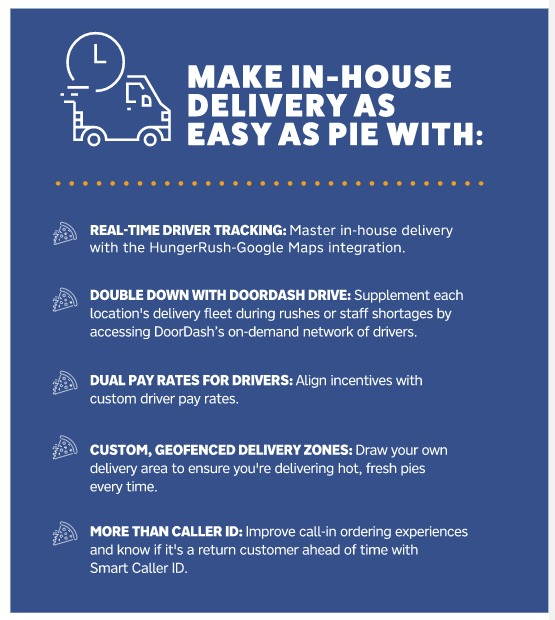
HungerRush delivery management software is built for restaurants that want full control of their delivery channel, from the moment a guest places an order to the moment it arrives at their door. It integrates natively with online ordering, loyalty, and reporting, so every delivery transaction contributes to a complete picture of your operation.
But don’t listen to us—here’s what our customers are saying:
“The delivery module of HungerRush has been a huge upgrade from our previous system and delivery wait time has improved. Delivery restaurants can definitely benefit from HungerRush.”
–Corey Rimmel, Hot Box Cookies
What stands out:
- Custom geofenced delivery zones give you control over where and how fast you deliver, without overpromising to guests outside your range.
- Dual pay rate options keep drivers engaged and incentivized, which matters for on-time performance during a busy shift.
- Full integration with OrderAI means phone orders, app orders, and delivery dispatch all flow through one connected system.
- Every guest data point belongs to you, not a third-party platform.
HungerRush was built from the ground up by restaurant industry veterans. We’ve spent nearly 20 years helping delivery-driven operations grow, and we understand what it takes to run high-volume delivery without losing guests to friction.
Learn more: How To Set Up Food Delivery Without Paying 30% Commissions On Every Order
2. Onfleet
Onfleet provides last-mile delivery solutions across a wide range of industries, including food service. Operators on G2 consistently recognize it for being straightforward to set up, with solid driver tracking, automatic guest notifications, and route optimization built in.
What stands out:
- Real-time driver tracking and analytics
- Automatic SMS delivery updates and estimated arrival times for guests
- Developer-friendly API for integration with your existing ordering platform
Onfleet is a well-built tool, but it’s designed as a general last-mile solution rather than a restaurant-first platform. If you need tight integration with your POS, loyalty, or guest marketing stack, you may find it lacks the restaurant-specific depth your operation requires.
Also Read: How to Set Up Food Delivery Without Paying 30% Commissions On Every Order
3. Relay
Relay is a delivery management platform built specifically for restaurants, with a focus on giving operators a viable alternative to the major third-party networks. It’s gained strong U.S. traction and is built around the needs of independent and multi-unit operators who want a dedicated delivery infrastructure without the commission structure of the big platforms.
What stands out:
- Built for restaurant delivery from the ground up, not adapted from a general logistics tool
- Supports both in-house driver fleets and third-party driver network integrations
- Real-time order tracking and direct guest communications
- Strong fit for operators who want to consolidate delivery under their own brand experience
Relay is a credible option for restaurants where delivery is a primary revenue driver. As with any platform, verify current POS and ordering integrations before committing.
4. DelivApp
DelivApp is an end-to-end ordering and delivery management system that also handles logistics. Like HungerRush, it was built with restaurant operators in mind, with a focus on helping independent businesses compete with the large third-party delivery platforms.
What stands out:
- Native iOS and Android apps
- Menu and inventory management across multiple locations
- A broad integration list, including ordering through messaging platforms
- Audio alerts for order issues, a small but practical feature during a high-volume service
Reviews on G2 recognize the system’s reliability and ease of use. Some users report occasional minor glitches on the web interface, but nothing that materially impacts daily operations.
Also Read: The Restaurant Food Costing Guide For Franchise Operators
5. DeliverLogic
DeliverLogic is an established food delivery software company with a portfolio of over 250 food ordering websites and a track record processing millions of orders per year. It’s a solid option for operators looking for a proven platform backed by U.S.-based support.
What stands out:
- Custom pickup and delivery software tailored to your brand
- 24/7 U.S.-based customer service with regionally available agents
- Marketing services that help your restaurant get found in local search and on relevant directories
DeliverLogic is well-established and broadly capable. Some users on review sites have noted slow menu loading times and inconsistent support experiences, so it’s worth testing responsiveness before committing.
First-Party Delivery Is a Better Business Decision
If you’re still sending a meaningful share of your delivery volume through third-party apps, you already know the economics don’t work long-term. First-party food delivery software gives you the control, the revenue, and the guest relationship that third-party platforms are designed to keep for themselves.
And with AI ordering becoming a standard part of the delivery workflow in 2026, the gap between restaurants with connected systems and those without is only going to grow.
HungerRush was built for this. Our delivery management system integrates natively with your POS, online ordering, loyalty, and AI ordering tools, so every order and every shift contributes to the same complete picture of your operation.
Frequently Asked Questions
What is restaurant food delivery software?
Restaurant food delivery software is a system that helps operators manage and dispatch delivery orders directly through their own operation, rather than routing through third-party apps like DoorDash or UberEats. It typically includes driver management, route optimization, real-time order tracking, and integration with your POS and online ordering platform.
What’s the difference between first-party and third-party delivery?
Third-party delivery means routing orders through external platforms like UberEats or Grubhub, which charge commission fees of up to 30% per order and retain the guest relationship. First-party delivery means taking orders directly through your own channels, keeping your revenue and your guest data.
How much does restaurant food delivery software cost?
Pricing varies widely depending on the platform, your order volume, and the features you need. Many solutions charge a monthly subscription fee plus per-order fees. The right comparison is total platform cost versus what you’re currently paying in third-party commissions. For most restaurants with consistent delivery volume, first-party software pays for itself.
Can food delivery software integrate with my existing POS system?
Most modern restaurant delivery management platforms offer POS integrations, though depth varies. HungerRush integrates delivery management natively with the POS, so order data, driver tracking, and guest records flow through one connected system without additional configuration.
What should I look for when evaluating food delivery management software?
Key criteria include POS integration quality, driver management capabilities, real-time tracking for guests, route optimization, access to backup driver networks like DoorDash Drive, and full ownership of guest data. In 2026, AI ordering readiness is also worth evaluating, as more operators are connecting phone and voice ordering directly into their delivery workflow.
How is AI ordering changing restaurant delivery in 2026?
AI ordering tools handle phone and voice orders automatically, routing them directly into your delivery dispatch workflow. This removes the manual step of taking phone orders during peak times, reduces errors, and keeps your delivery pipeline moving even when the team is stretched. Major QSR brands deployed AI ordering at scale in 2025 and 2026, and the technology is increasingly accessible for independent and mid-market operators. Platforms that connect AI ordering with delivery management, like HungerRush, give operators a meaningful operational advantage.